Annular eclipse
- ✓ The Moon does not cover the entire Sun.
- ✓ A ring of sunlight remains visible.
- ✓ There is no totality.
- ✓ Eye protection stays on throughout direct viewing.
Understand the phenomenon
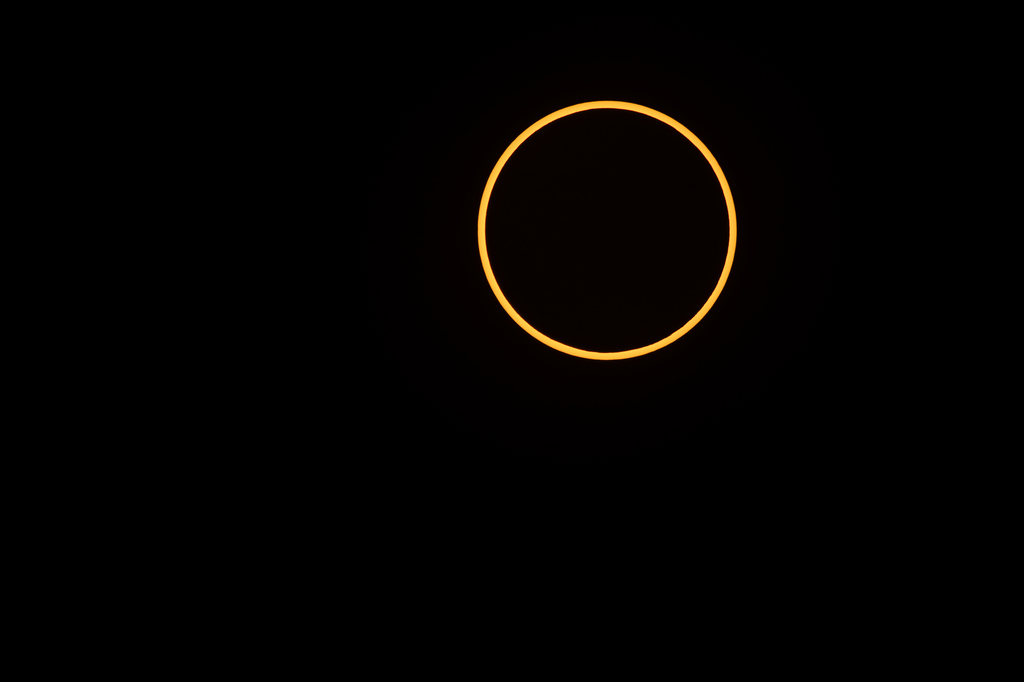
An annular eclipse happens when the Moon passes in front of the Sun but its apparent size is not large enough to cover it completely. The result is one of the sky’s most recognisable sights: a dark lunar disc surrounded by a ring of sunlight.
The idea in 20 seconds
NASA explains that annularity occurs when the Moon passes between Earth and the Sun while far enough away to appear slightly smaller. From a narrow path on Earth, the discs align and a rim of the Sun’s bright face remains visible.
Sun, Moon and Earth align.
The Moon appears slightly smaller than the Sun.
The “ring of fire” remains visible.
Annular vs total

What you may notice
As obscuration increases, daylight can feel unusual and small crescent-shaped projections may appear in shadows. Temperature can shift and the ring itself is highly photogenic. The experience should not, however, be sold as though daytime turns into night.
The most important safety rule
NASA states that because there is no totality, safe eclipse glasses or a handheld solar viewer are required throughout direct viewing. Ordinary sunglasses are not safe. Cameras, binoculars and telescopes require special-purpose solar filters over the front of the optics.
Read the full safety guide →No. The Moon never completely covers the Sun’s bright face, so there is no period of totality.
Ambient light can dim and feel unusual, but it does not produce the deep darkness associated with totality.
The Moon is far enough from Earth to look slightly smaller than the Sun. When the two discs align, a bright rim of the Sun remains visible.
No. Part of the bright Sun remains visible throughout annularity, so proper solar viewing protection is required for direct viewing at all times.
No. The ring is visible only inside the path of annularity. Outside that path the eclipse is partial.
Primary sources: NASA Science — Eclipse Viewing Safety; NASA Scientific Visualization Studio — Annular Eclipse Imagery. Historical photographs illustrate the appearance of annularity and do not represent the exact sky on 6 February 2027.